Others
Spatial ordering, nearest-neighbour search and learnable superquadric primitives. 4 figures.
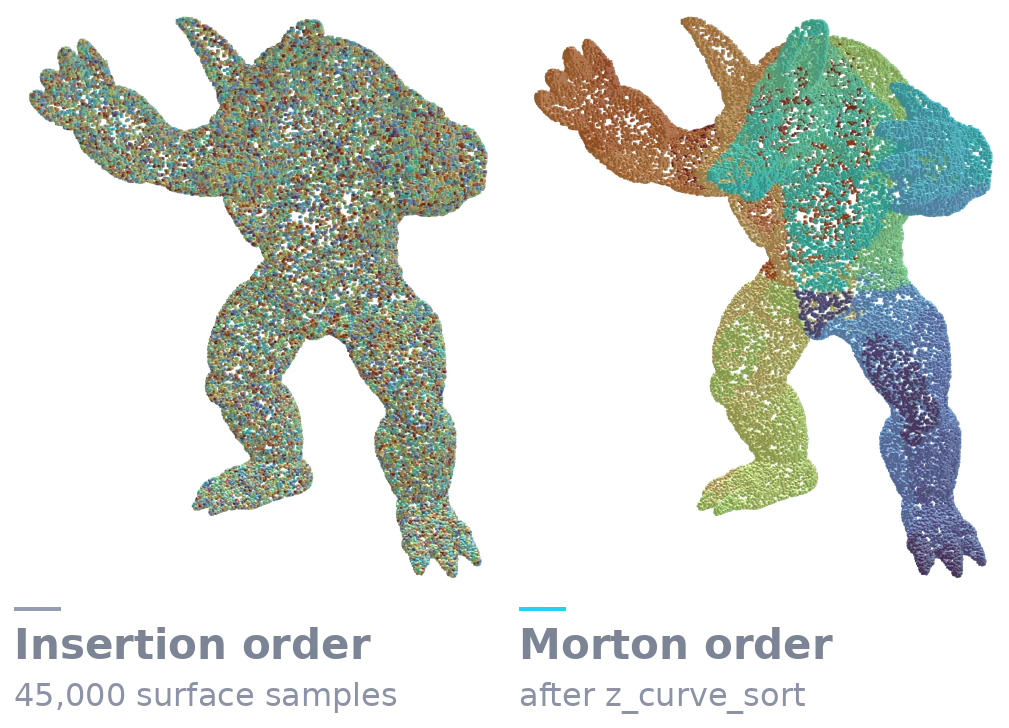
Morton ordering
Points before and after sorting by Morton code, coloured by their position in memory.
from conquer3d.data_structure import z_curve_sort

points = mesh.sample_points(100_000)[0].contiguous()

# Morton order: points close in space end up close in
# memory, which is what makes later tree builds coherent.
ordered = z_curve_sort(points)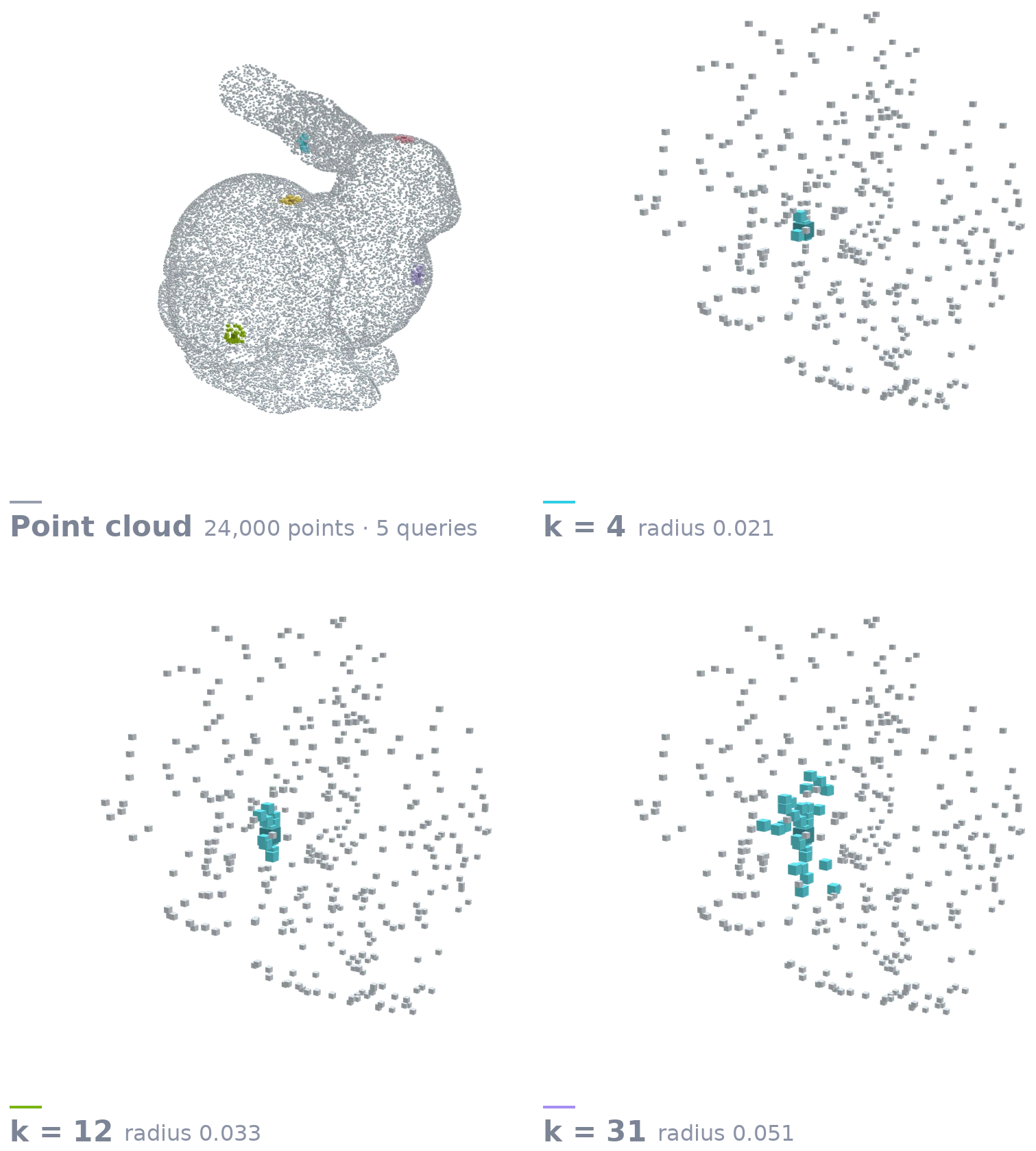
Nearest neighbours
Five query points in a 24,000-point cloud sampled from the bunny, with one neighbourhood shown close up as k grows.
from conquer3d._C import KDTree

# The tree indexes points, never the triangles.
points = mesh.sample_points(24_000)[0].contiguous()
tree = KDTree(points)

# exclude_self drops the query point itself when the
# queries come from the cloud being searched.
distances, indices = tree.query(queries, k=12,
                                exclude_self=True)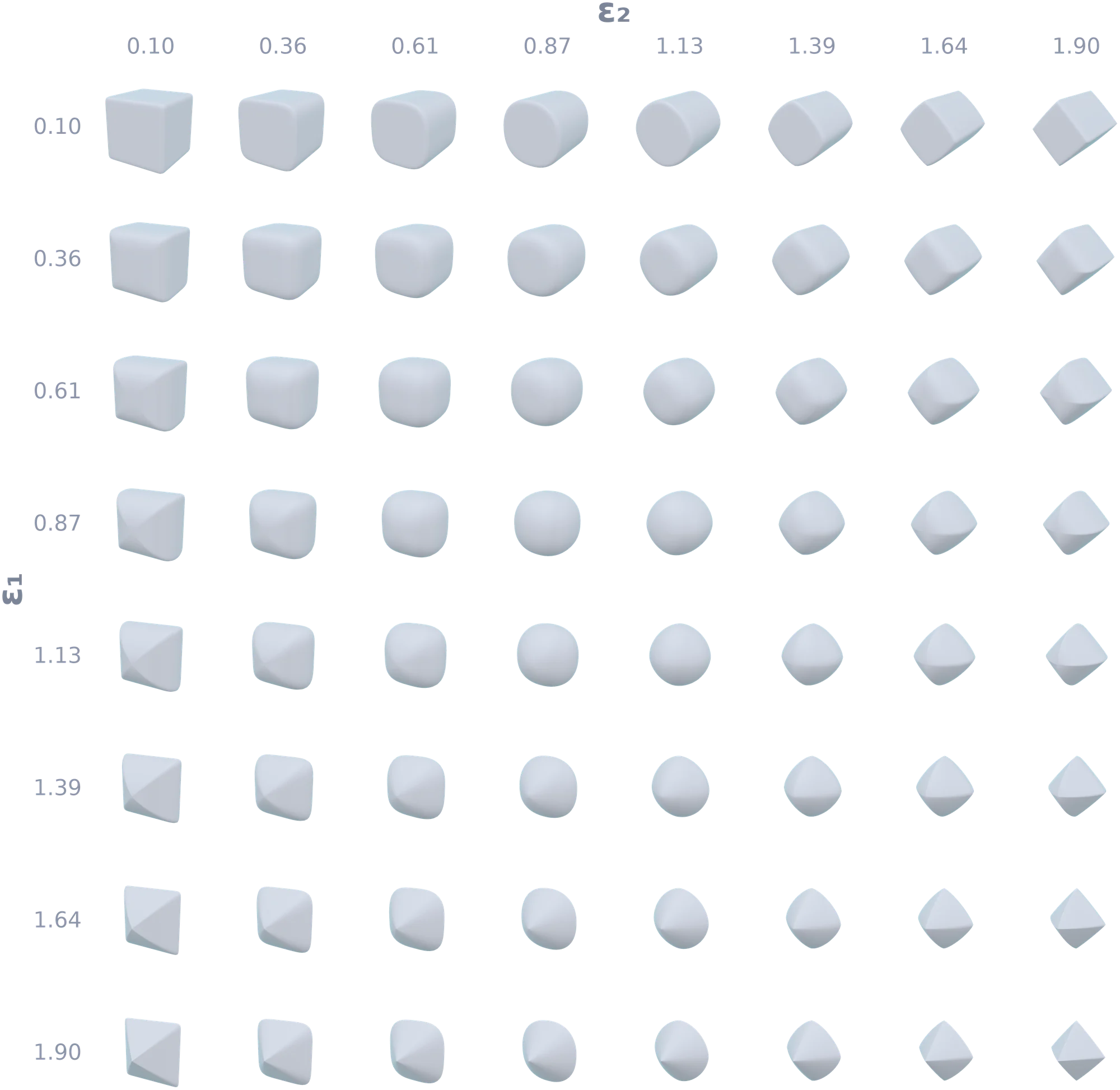
Superquadric shape family
Both shape exponents swept across their range, from box through ellipsoid to pinched star.
import torch
from conquer3d.primitive import SuperQuadrics
from conquer3d.primitive.sq import (
    MAX_EXPONENT, MIN_EXPONENT,
)

# e -> 0 is a box, e = 1 an ellipsoid, e -> 2 a star.
steps = 8
axis = torch.linspace(MIN_EXPONENT, MAX_EXPONENT, steps,
                      device="cuda")
count = steps * steps

sq = SuperQuadrics.from_values(
    scales=torch.ones(count, 3, device="cuda"),
    exponents=torch.stack([axis.repeat_interleave(steps),
                           axis.repeat(steps)], dim=-1),
    quaternions=torch.eye(4, device="cuda")[0].repeat(
        count, 1),
    translations=torch.zeros(count, 3, device="cuda"),
    learnable=False,
)
verts, faces = sq.get_mesh(resolution=64)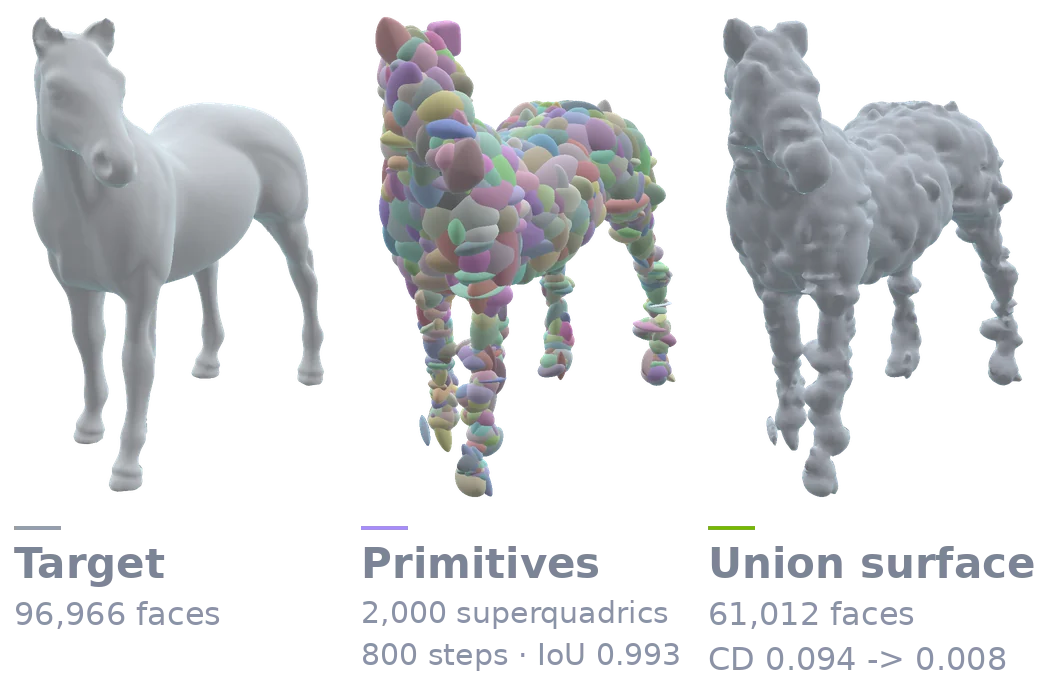
Superquadric fitting
Two thousand superquadrics fitted to a horse by gradient descent, and the union of their fields extracted as one watertight surface.
from conquer3d.data_structure import create_voxel_grid
from conquer3d.ops import marching_cubes
from conquer3d.primitive import (
    SuperQuadrics, compute_sq_union,
)

sq = SuperQuadrics(num_quadrics=2000, device="cuda")

for step in range(600):
    optimizer.zero_grad(set_to_none=True)
    fields, union = sq(points, return_union=True)
    union.abs().mean().backward()
    optimizer.step()

# get_mesh() keeps surface buried inside overlapping
# primitives. The union boundary is the honest one, so
# extract it from the union field instead.
gv, vox, _ = create_voxel_grid(
    grid_min=[-0.62] * 3, grid_max=[0.62] * 3,
    res=[512] * 3, device="cuda")
field = compute_sq_union(sq(gv), tau=sq.union_tau,
                         mask=sq.mask)
verts, faces = marching_cubes(gv, vox, field, iso=0.0)[:2]